/reboot/media/61cb254a-5449-11f1-9245-be6ded8add9d/06404b14-5dc8-11f1-aa1d-86f89b305e2b/1-1-1780324909780.png)
Recreating immersive natural environments to stimulate employee creativity : The Lab in The Bag has tested it for you
What you'll learn in this article
|
Being out in nature feels good. You've surely experienced it yourself : whether in the mountains, the forest, or by the sea, you feel at peace, you lose track of time… and sometimes you even come home with new ideas. It's no coincidence ! It's science. Numerous studies in management, psychology, and neuroscience have shown that natural environments foster creativity. The Lab In The Bag has partnered with Repères to launch an ambitious research program : studying the effect of physical and sensory work environments on creativity. In this article, we take you behind the scenes of our first series of experiments, focused on the effect of immersive natural environments on idea generation.
Creativity, an essential part of the innovation process
Whether you're a product manager, innovation director, designer, or sensory specialist, one thing is certain : you need creativity ! Indeed, creativity is deeply intertwined with the innovation process. Without it, there's no agility, no breakthroughs in product development.
For nearly 10 years, The Lab In The Bag has been developing immersive, multi-sensory rooms designed to be seamlessly integrated into your spaces. These systems deliver video and audio, combined with a wide range of effects (scent, mist, ventilation, and temperature control), to instantly whisk you away to the environment of your choice. Although our rooms can be used in many different ways, we have embarked on a brand-new path : providing a research-based protocol that can be directly implemented in your own room to stimulate your teams' creativity.
Three series of experiments to identify the optimal conditions for creativity
To design this protocol, we are using one of our largest immersive installations : the 80-square-meter facility located at the Institut Lyfe (Ecully), featuring 360° screens and multiple sensory devices. This work is led by our PhD student Lou-Anne Delaroque, under the supervision of François Abiven, CEO of Repères, as well as Guy Parmentier (creativity researcher) and Marielle Salvador (sensory marketing researcher).
A systematic review of the literature conducted beforehand highlighted the importance of natural work environments in stimulating creativity. Similarly, the colors present in these environments have also been identified as decisive. It is widely accepted that solving a creative problem relies on two complementary mechanisms, which individuals alternate between : divergent thinking, which involves generating a large number of varied ideas, and convergent thinking, which involves selecting or retaining only a single solution from among the ideas generated. Studies thus show that cooler colors such as green and blue are more conducive to divergent thinking, while warmer colors such as red or orange are more conducive to convergent thinking.
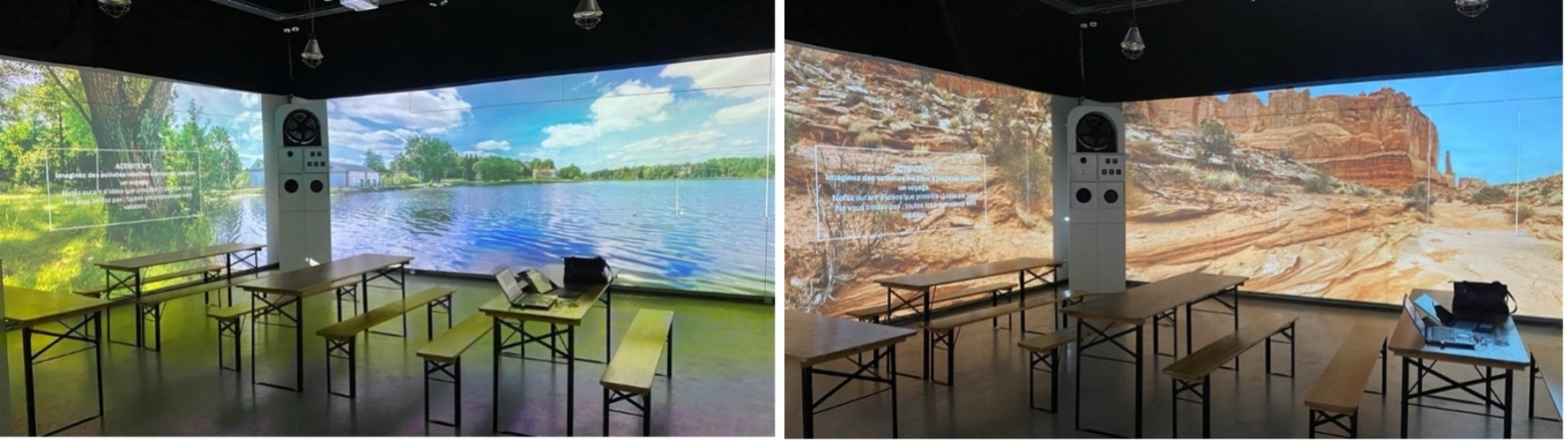
Thus, two natural environments were compared in an immersive room to measure their effect on creativity: a natural environment with a green/blue predominance and a natural environment with a red/orange predominance. To achieve a 360° visual display, we used equirectangular 2:1 images imported into the immersive room's interface. Natural soundtracks were also added to match the visual environments (birdsong and the lapping of water for the blue/green environment, cicadas and wind for the red/orange environment).
To measure the effect of environments on creativity, a two-step activity was designed, the first one requiring divergent thinking and the other convergent thinking. In the first half, participants were asked to generate as many original travel ideas as possible. Then, in the second part, the goal was to select one idea from those generated and develop it in order to convince a travel agency to adopt it. A questionnaire was then completed to identify the psychological mechanisms at play during the session. Each session lasted a total of about 30 minutes.
Three rounds of experiments were conducted, involving a total of 160 participants :
- Experiment 1 : Participants were placed in either a dark forest environment, a dark desert environment, or a light control environment (uniform gray background). The creative activity and questionnaire were administered and completed on a touchscreen tablet with a keyboard.
- Experiment 2 : The procedure was the same as in Experiment 1, except that the gray control environment was dark.
- Experiment 3 : Participants were placed in either a light forest environment or a light desert environment. There was no control environment. The prompts for the creative activity were directly integrated into the visual environment, and participants wrote their responses on a sheet of paper. The questionnaire was then completed on a cell phone.
Have an immersive room project ? Let's talk.
Early results and findings
Preliminary results show that, across the different sessions, the natural environment with a green/blue color scheme tends to foster more original ideas during the first phase of the activity (divergent thinking phase). A comparison with the gray control environments (light in Experiment 1, dark in Experiment 2) also revealed the importance of lighting on creative performance. Thus, a poorly illuminated environment tends to reduce individuals' creativity, regardless of the environment's content.
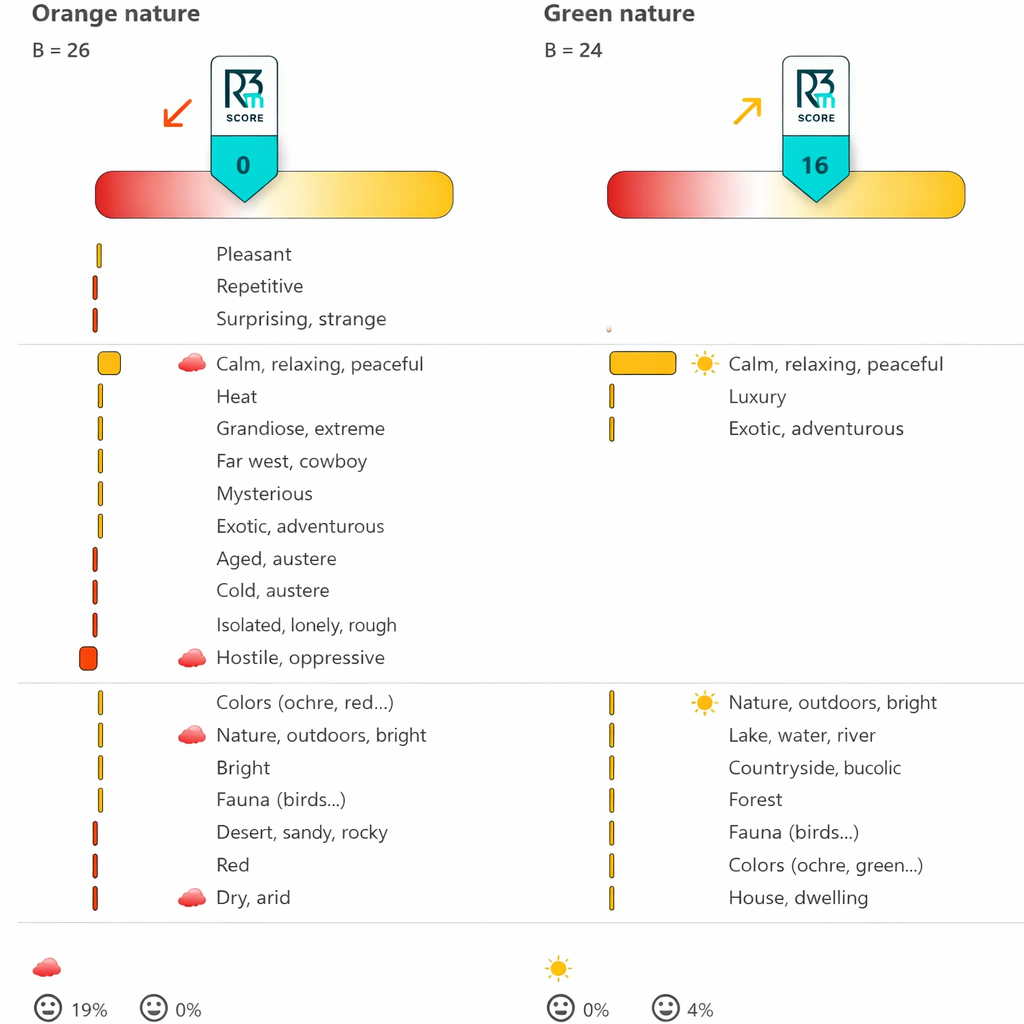
Among the underlying psychological mechanisms studied, the loss of the sense of time (a component of the flow state) proved to be a decisive marker of creative performance. Both natural environments also passed the R3M Score test, a tool developed exclusively by Repères to assess emotional arousal in response to a stimulus. The results showed that the green/blue-dominated natural environment is perceived more positively than the red/orange-dominated environment. This difference in emotional activation could explain the results obtained on the originality score in the first part of the creative activity, which favored the green/blue-dominated environment.
What can we retain from this first phase of experiments ?
- A natural, immersive audiovisual environment with a green/blue color tone can promote creativity, particularly in terms of the originality of the ideas generated (during the divergence phase).
- A minimum level of lighting must be maintained so as not to hinder the creative process.
- Positive emotional engagement and a loss of sense of time are key factors when it comes to fostering creativity through sensory environments.
To continue investigating the effect of sensory environments on creativity, we will further explore the capabilities of our immersive rooms, including the use of scent diffusion. Stay tuned for more !
Our immersive The Lab In The Bag solutions open up a world of possibilities far beyond this example. Feel free to contact us to discuss your project.
/reboot/media/61cb254a-5449-11f1-9245-be6ded8add9d/78c178e2-2791-11f1-b355-4e89eb076b4b/1-1-salle-immersive-figure-1-standard-divergence.png)
/reboot/media/61cb254a-5449-11f1-9245-be6ded8add9d/250322a8-3d7d-11f1-893b-0ef837368c5c/1-1-table-lab-1.png)
/reboot/media/61cb254a-5449-11f1-9245-be6ded8add9d/8126daa8-278d-11f1-af55-4e89eb076b4b/1-1-table-solo-lab-bois.jpg)